I. Why a Successful Prototype Is Not Yet Production-Ready
A prototype can demonstrate that a product’s concept, functionality, and basic design are feasible. However, a successful prototype does not automatically mean the product is ready for mass production.
During prototype development, the primary objective is often to verify functionality and identify design issues. Production requires a broader level of readiness: the product must be manufacturable through a repeatable process, meet defined quality requirements, and support the intended production volume and delivery schedule.
Several challenges may emerge when moving from prototype to mass production:
1.1 Manufacturing Processes May Need to Change
A process that works well for a small number of prototypes may not be suitable for larger production volumes. For example, CNC machining can be effective for producing and refining a small batch of metal components. For higher volumes, injection molding or another process may become worth evaluating, depending on the component geometry, material, tooling investment, dimensional requirements, and expected demand.
The goal is not simply to replace one process with another, but to identify a manufacturing approach that meets the product’s technical and commercial requirements.
1.2 Design Details Can Create Production Difficulties
Features that are acceptable in a prototype may introduce unnecessary complexity during production. Tight tolerances, difficult-to-machine geometries, inconsistent wall thicknesses, challenging mold features, or poorly defined assembly interfaces can affect manufacturability, quality consistency, and production efficiency.
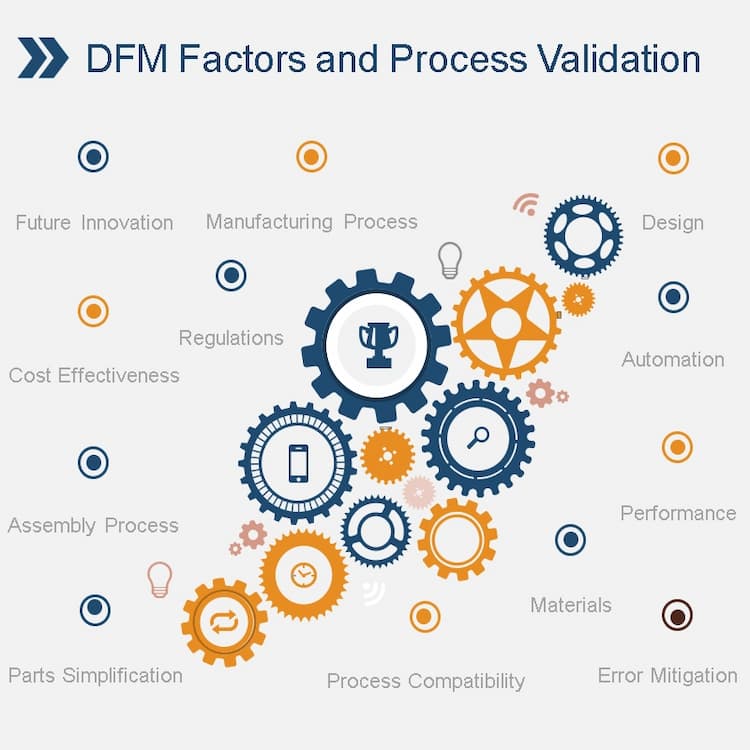
These issues are easier to address before tooling is finalized or production quantities increase. A design for manufacturability (DFM) review helps identify potential problems and evaluate practical alternatives.
1.3 Quality Must Be Repeatable, Not Just Demonstrated Once
A prototype that passes an initial inspection provides useful evidence, but it does not establish that every subsequent production batch will meet the same requirements.
Repeatable manufacturing depends on appropriate process parameters, suitable tooling and fixtures, defined inspection criteria, and effective quality controls. Where necessary, trial production and process validation help confirm that the selected manufacturing approach can consistently deliver conforming parts.
1.4 Production Capacity and Supply Coordination Become More Important
Small prototype orders can often be managed with flexible scheduling and close attention to individual parts. Larger production runs require more systematic planning for materials, tooling availability, process capacity, production scheduling, and coordination between suppliers or manufacturing stages.
For products involving metal components, molded plastic, silicone parts, PCBA, cables, and final assembly, the readiness of each individual component does not necessarily guarantee that the complete product can be delivered on schedule. The overall manufacturing plan must account for how these elements fit together.
1.5 From Prototype Success to Production Readiness
The transition to mass production should therefore be treated as a structured engineering and manufacturing process, rather than simply an increase in order quantity.
Before scaling up, teams should evaluate whether the design is suitable for the selected processes, critical requirements are clearly defined, quality controls are established, and production resources can support the expected demand.
Addressing these questions early helps reduce avoidable changes, production delays, and quality risks later in the project.