From Prototype to Mass Production: How DFM and Process Validation Improve Manufacturing Efficiency

I. Why a Successful Prototype Is Not Yet Production-Ready


A prototype can demonstrate that a product’s concept, functionality, and basic design are feasible. However, a successful prototype does not automatically mean the product is ready for mass production.

During prototype development, the primary objective is often to verify functionality and identify design issues. Production requires a broader level of readiness: the product must be manufacturable through a repeatable process, meet defined quality requirements, and support the intended production volume and delivery schedule.

Several challenges may emerge when moving from prototype to mass production:
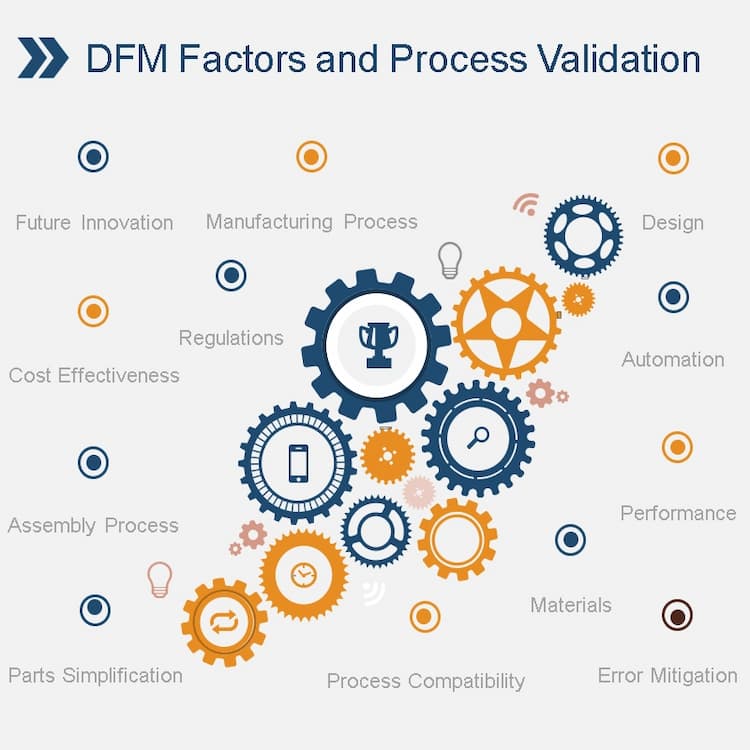


1.1 Manufacturing Processes May Need to Change

A process that works well for a small number of prototypes may not be suitable for larger production volumes. For example, CNC machining can be effective for producing and refining a small batch of metal components. For higher volumes, injection molding or another process may become worth evaluating, depending on the component geometry, material, tooling investment, dimensional requirements, and expected demand.

The goal is not simply to replace one process with another, but to identify a manufacturing approach that meets the product’s technical and commercial requirements.

1.2 Design Details Can Create Production Difficulties

Features that are acceptable in a prototype may introduce unnecessary complexity during production. Tight tolerances, difficult-to-machine geometries, inconsistent wall thicknesses, challenging mold features, or poorly defined assembly interfaces can affect manufacturability, quality consistency, and production efficiency.

These issues are easier to address before tooling is finalized or production quantities increase. A design for manufacturability (DFM) review helps identify potential problems and evaluate practical alternatives.

1.3 Quality Must Be Repeatable, Not Just Demonstrated Once

A prototype that passes an initial inspection provides useful evidence, but it does not establish that every subsequent production batch will meet the same requirements.

Repeatable manufacturing depends on appropriate process parameters, suitable tooling and fixtures, defined inspection criteria, and effective quality controls. Where necessary, trial production and process validation help confirm that the selected manufacturing approach can consistently deliver conforming parts.

1.4 Production Capacity and Supply Coordination Become More Important

Small prototype orders can often be managed with flexible scheduling and close attention to individual parts. Larger production runs require more systematic planning for materials, tooling availability, process capacity, production scheduling, and coordination between suppliers or manufacturing stages.

For products involving metal components, molded plastic, silicone parts, PCBA, cables, and final assembly, the readiness of each individual component does not necessarily guarantee that the complete product can be delivered on schedule. The overall manufacturing plan must account for how these elements fit together.

1.5 From Prototype Success to Production Readiness

The transition to mass production should therefore be treated as a structured engineering and manufacturing process, rather than simply an increase in order quantity.

Before scaling up, teams should evaluate whether the design is suitable for the selected processes, critical requirements are clearly defined, quality controls are established, and production resources can support the expected demand.

Addressing these questions early helps reduce avoidable changes, production delays, and quality risks later in the project.

II. What Is Design for Manufacturability (DFM)?


Design for Manufacturability (DFM) is the process of evaluating a product’s design to determine how easily, consistently, and efficiently it can be manufactured using suitable production processes.

Rather than treating manufacturing as a step that begins after design is complete, DFM considers manufacturing requirements during engineering review. It helps identify potential production difficulties early, when design adjustments are generally easier to evaluate and implement.

The objective is not simply to make a product cheaper. A well-executed DFM review considers the balance between functionality, quality, manufacturing feasibility, production efficiency, and overall project requirements.

2.1 What Does a DFM Review Examine?

A DFM review typically examines several aspects of the product and its intended manufacturing route.

  • Geometry and feature design

Component geometry directly affects manufacturing complexity. Deep cavities, thin walls, difficult-to-access features, complex internal structures, and unnecessary design details may require specialized tooling or additional operations. Engineers evaluate whether these features can be simplified without compromising the product’s intended function.

  • Dimensional tolerances and critical requirements

Tolerances should reflect actual functional and assembly requirements. Overly tight tolerances can increase machining time, tooling requirements, inspection effort, and production difficulty. A DFM review identifies critical dimensions and checks whether the proposed manufacturing process can achieve them consistently.

  • Material selection

Material properties influence process selection, tooling design, dimensional stability, durability, and final product performance. The review considers whether the selected material is suitable for both the intended application and the proposed manufacturing process.

  • Tooling and production method

Different processes have different capabilities and limitations. CNC machining, injection molding, silicone molding, and 3D printing, for example, differ in tooling requirements, achievable geometries, production rates, and suitability for different order quantities. DFM helps evaluate whether the selected process fits the product and production plan.

  • Assembly interfaces and integration

For multi-component products, individual parts must work together as a complete system. DFM considers mating features, alignment, fastening methods, component clearances, cable routing, and assembly access where relevant. Reviewing these interfaces early can help prevent fit problems and unnecessary assembly complexity.

  • Inspection and quality control

A component must not only be manufacturable; its critical requirements must also be verifiable. The review considers whether important dimensions, material characteristics, and functional requirements can be inspected or tested using appropriate methods.

2.2 How DFM Supports Better Manufacturing Decisions

The value of DFM lies in identifying potential problems before they become expensive production issues.

For example, a custom product may contain a precision-machined metal housing, an injection-molded plastic cover, silicone sealing components, and electronic assemblies. Each component may be feasible to manufacture individually, yet the complete product could still face challenges involving tolerance compatibility, sealing performance, fastening, or assembly access.

A coordinated DFM review examines these interfaces alongside the individual manufacturing requirements. Depending on the findings, the team may refine a component feature, clarify a tolerance, evaluate an alternative process, or revise the assembly sequence.

Any proposed change must still be checked against functional, regulatory, safety, and customer requirements, as applicable. DFM should improve manufacturability without compromising what the product is designed to do.

2.3 When Should DFM Be Conducted?

DFM is most useful when it begins early enough to influence manufacturing decisions, but it can also identify improvement opportunities after a prototype has been built.

Common review stages include:

  • Before prototyping: Evaluate initial CAD models, materials, tolerances, and potential manufacturing routes.
  • After prototype evaluation: Review observed defects, fit issues, assembly difficulties, and opportunities for design refinement.
  • Before tooling or production commitment: Confirm that key design and process assumptions have been reviewed and that outstanding issues are understood.
  • Before production ramp-up: Check that approved design revisions, manufacturing methods, inspection requirements, and assembly interfaces are aligned.

The depth of review depends on product complexity, risk, production volume, and customer requirements. Not every project requires the same level of formal validation, but important manufacturing assumptions should be addressed before they create avoidable problems.

DFM provides the foundation for moving from design intent to a practical manufacturing plan. Once the design and requirements have been reviewed, the next step is to evaluate whether the selected manufacturing processes are appropriate for the product and its expected production volume.

III. Evaluate the Manufacturing Process Before Scaling


Selecting the right manufacturing process is a critical step in moving from prototype to mass production. A process that works well for an initial prototype may not be the most suitable option for repeat production, while a process designed for high-volume manufacturing may require a level of tooling investment that is difficult to justify during early development.

The right choice depends on the product’s geometry, material, dimensional requirements, expected production volume, tooling budget, and delivery schedule. These factors should be evaluated together rather than considered in isolation.

3.1 Understand the Strengths and Limitations of Different Processes

Each manufacturing process has its own capabilities, constraints, and production economics. Understanding these differences helps engineering and procurement teams identify practical options before committing to tooling or scaling production.

Manufacturing process Common applications Key considerations
CNC machining Precision metal and plastic components, housings, brackets, and functional prototypes Material removal, tool access, machining time, tolerances, and material utilization
Injection molding Plastic housings, covers, enclosures, and repeat-production components Mold investment, part geometry, draft, wall thickness, cooling, and expected volume
Silicone molding Seals, gaskets, flexible components, and custom silicone parts Material properties, mold design, curing requirements, dimensional control, and application needs
3D printing Design prototypes, complex geometries, and selected low-volume parts Material and process limitations, surface finish, dimensional performance, and suitability for end use
PCBA and cable assembly Electronic control boards, wiring harnesses, and connected subsystems Component availability, electrical requirements, assembly processes, testing, and traceability where required
Product assembly and integration Multi-component products combining mechanical, electrical, and molded parts Component compatibility, assembly sequence, fastening, alignment, testing, and packaging

These are general guidelines rather than fixed rules. The suitability of each process depends on the specific design, material, required performance, and manufacturing conditions.

3.2 Balance Production Volume, Tooling Investment, and Unit Cost

Production volume can significantly influence process selection.

CNC machining may be suitable for prototypes, design iterations, and certain low- or medium-volume applications because it can often avoid dedicated production molds. However, machining time and material removal may become significant considerations as quantities increase.

Injection molding typically requires a greater upfront investment in tooling, but it can offer efficient repeat production when the component design, material, and volume justify that investment.

The important point is that neither process is universally better. A meaningful comparison should consider the total manufacturing picture, including tooling, material consumption, cycle time, finishing, inspection, assembly, and expected demand.

For example, a custom plastic enclosure might initially be produced through CNC machining or 3D printing to evaluate its fit and functionality. Once the design is sufficiently stable and expected demand is understood, injection molding can be assessed as a production option. The timing of that transition depends on the project’s requirements and commercial assumptions.

3.3 Consider the Complete Manufacturing Route

Manufacturing processes should not be evaluated solely at the individual component level. The selected process must also support the way parts are finished, inspected, assembled, and integrated into the final product.

Consider a product containing a CNC-machined aluminum housing, an injection-molded cover, silicone seals, a PCBA, and connecting cables. Each component may require a different manufacturing method, but the final product depends on all of them working together.

Several questions should therefore be considered during process evaluation:

  • Can the selected processes achieve the required dimensions and functional performance?
  • Are material properties and component interfaces compatible?
  • Can finishing and secondary operations be completed without compromising quality?
  • Are inspection and functional testing requirements clearly defined?
  • Can component supply and production scheduling support the planned assembly sequence?

Reviewing these questions early can help identify potential problems before they affect tooling decisions, production schedules, or final assembly.

3.4 Reassess Process Selection as the Product Develops

Process selection is not always a one-time decision. Prototype results, revised design requirements, supplier capabilities, and updated volume forecasts may justify a reassessment.

However, changing processes can also introduce new tooling requirements, qualification work, dimensional differences, or validation needs. Any proposed change should therefore be evaluated against its expected benefits and the additional risks or resources involved.

Before committing to mass production, teams should document the selected manufacturing route, confirm that critical requirements can be met, and identify any remaining technical or production risks that need to be addressed.

The objective is to select a manufacturing process—or a coordinated combination of processes—that can meet the product’s requirements consistently at the intended production scale. With the manufacturing route established, the next step is to review critical dimensions, materials, and component interfaces in greater detail.

IV. Review Critical Dimensions, Materials, and Interfaces


Selecting a suitable manufacturing process is only part of production readiness. Even when individual components can be manufactured successfully, dimensional variation, material incompatibility, or poorly defined assembly interfaces can prevent the complete product from meeting its requirements.

Reviewing these factors before tooling and mass production helps identify potential problems early and establishes clearer expectations for manufacturing, inspection, and assembly.

4.1 Identify Critical Dimensions and Set Appropriate Tolerances

Not every dimension has the same impact on product performance. Some dimensions directly affect fit, sealing, alignment, movement, or functional operation, while others may have little effect on the finished product.

During engineering review, dimensions should be evaluated according to their functional importance. Critical dimensions may require tighter tolerances and more specific inspection methods, while non-critical features may allow greater manufacturing flexibility.

For example, a housing with a sealing interface may require careful control of the sealing surface, groove dimensions, and mating features. Applying unnecessarily tight tolerances to unrelated external features, however, may increase machining and inspection requirements without providing a corresponding functional benefit.

Tolerance decisions should therefore consider:

  • Functional and assembly requirements.
  • The capabilities and variation of the selected manufacturing process.
  • Material behavior, including shrinkage or dimensional changes where relevant.
  • Inspection methods and measurement uncertainty.
  • The consequences of dimensional variation on product performance.

The objective is to define tolerances that are sufficient for the product’s intended function and realistically achievable through the selected manufacturing process.

4.2 Evaluate Tolerance Stack-Up Across Multiple Components

In multi-component products, individual parts can meet their own dimensional specifications while the assembled product still experiences fit or alignment problems.

This can occur because dimensional variations accumulate across mating features or a chain of assembled components. This is commonly referred to as tolerance stack-up.

Consider a product consisting of a machined metal housing, a molded plastic cover, and a silicone seal. The housing and cover establish the assembly geometry, while the seal must deform appropriately to achieve the intended sealing performance. Variations in the mating dimensions, groove geometry, or seal characteristics can affect the final assembly.

A tolerance stack-up review helps determine which dimensions influence the assembled result and whether the proposed tolerances are sufficient.

Depending on the application, engineers may use worst-case analysis, statistical tolerance analysis, or other suitable methods. The appropriate approach depends on the functional risk, production requirements, and available dimensional data.

4.3 Confirm Material Compatibility and Process Requirements

Material selection affects more than a component’s strength or appearance. It can also influence manufacturing feasibility, dimensional stability, durability, assembly, and performance in the intended environment.

For products combining different materials, the review should consider how those materials interact during manufacturing and use.

Examples include:

  • Metal and plastic: Differences in thermal expansion, stiffness, and dimensional behavior may affect clearances, fastening, and alignment.
  • Plastic and silicone: Contact geometry, compression, chemical compatibility, and environmental exposure may influence sealing or functional performance.
  • Mechanical and electronic components: Temperature exposure, moisture protection, vibration, and assembly methods may affect the reliability of integrated products.

Material and process requirements must be evaluated together. A material that performs well in isolation may still require changes to the manufacturing method, component geometry, or assembly design.

Where the application requires specific regulatory, safety, or performance compliance, those requirements should also be incorporated into material selection and verification.

4.4 Design Assembly Interfaces for Repeatable Production

Assembly interfaces determine how components locate, connect, and remain secure within the finished product. Poorly defined interfaces can create difficulties even when individual components are manufactured to specification.

A practical review should consider locating features, clearances, fastening methods, alignment, access for assembly tools, and the sequence in which components are installed.

For example, a product that combines molded components, a cable assembly, and a machined enclosure may require sufficient clearance for cable routing, reliable positioning of the electronic assembly, and access to fastening points. These requirements should be considered before production tooling and assembly procedures are finalized.

Where appropriate, fixtures, gauges, or functional checks can help confirm that components fit together consistently. Assembly trials can also reveal issues that may not be apparent from drawings or individual part inspections alone.

4.5 Translate Engineering Requirements into Inspection Criteria

Once critical dimensions, materials, and interfaces have been identified, the requirements need to be translated into practical inspection and verification methods.

A manufacturing drawing or specification should clearly communicate relevant dimensions, tolerances, material requirements, surface or finish requirements, and other characteristics that affect product acceptance.

The inspection plan should then identify which characteristics require measurement, how they will be checked, and what acceptance criteria apply. Depending on the product, this may involve dimensional inspection, visual examination, material verification, assembly checks, or functional testing.

Not every feature requires the same inspection frequency or method. Inspection effort should reflect the importance of the characteristic, the associated risk, and the demonstrated stability of the manufacturing process.

The goal is to connect design requirements with manufacturing capability and verifiable quality criteria. Once these requirements are understood, prototype testing can be used to identify remaining issues and guide design refinement before production is scaled

V. Prototype Testing and Design Refinement


Prototype testing helps determine whether a product meets its functional, dimensional, material, and assembly requirements. It also reveals manufacturing challenges that may not be obvious from CAD models, engineering drawings, or individual component inspections.

However, the value of prototype testing depends on how the results are used. Identifying a problem is only the first step; the team must understand its cause, evaluate possible solutions, and confirm that the proposed changes work before committing to larger production quantities.

5.1 Define What the Prototype Needs to Prove

Before testing begins, the team should establish what needs to be verified and how success will be measured.

Depending on the product, prototype evaluation may include:

  • Functional testing: Confirming that the product performs its intended functions under defined conditions.
  • Dimensional inspection: Checking critical dimensions, clearances, fit, and alignment against engineering requirements.
  • Material and environmental evaluation: Assessing relevant properties such as flexibility, strength, temperature resistance, or chemical compatibility.
  • Assembly evaluation: Checking component fit, fastening, installation sequence, accessibility, and ease of assembly.
  • Reliability testing: Evaluating performance under specified operating conditions or repeated use, where required.

The appropriate tests depend on the product’s intended application, risk, customer specifications, and applicable regulatory requirements. A prototype that passes a basic functional test should not automatically be considered validated for every intended use.

5.2 Use Test Results to Identify the Root Cause

When a prototype fails to meet a requirement, the team should distinguish the observed symptom from its underlying cause.

For example, a plastic cover may not fit correctly onto a machined metal housing. The immediate symptom is poor fit, but possible causes include dimensional variation, insufficient clearance, material shrinkage, fixture-related variation, or an issue with the assembly method.

The team should examine relevant measurements, manufacturing records, material information, and assembly conditions before deciding on a corrective action.

This matters because changing the design without understanding the cause may solve one problem while creating another. A modification that improves fit, for example, could affect sealing, structural strength, appearance, or the performance of adjacent components.

5.3 Refine the Design Without Losing Sight of Manufacturing

Prototype findings may lead to changes in component geometry, tolerances, materials, fastening methods, or assembly interfaces.

Each proposed change should be evaluated against both product requirements and manufacturing feasibility. A design adjustment that improves functionality may also introduce additional machining operations, more complex tooling, difficult inspection requirements, or new assembly steps.

A structured review should therefore consider:

  • What problem is the change intended to resolve?
  • Does the change preserve the product’s critical functional and performance requirements?
  • How will it affect manufacturing processes, tooling, tolerances, and assembly?
  • What additional testing or inspection is needed?
  • Which drawings, specifications, or related documents must be updated?

This approach helps ensure that design refinement improves the overall product rather than addressing one isolated issue at the expense of production readiness.

5.4 Verify Changes Through Controlled Iteration

After a design or process adjustment, the relevant characteristics should be checked again. Depending on the nature of the change, this may require a new prototype, a modified sample, additional dimensional inspection, or repeat functional testing.

For example, if a housing interface is revised to improve component fit, the team should verify the revised dimensions and confirm that the assembled product still meets its functional requirements. If the change affects sealing or fastening, those functions may also need to be retested.

The scope of verification should reflect the impact of the change. Minor revisions may require limited checks, while changes affecting critical functions, materials, tooling, or safety-related characteristics may require more extensive evaluation.

Design revisions should also be documented and controlled so that all parties work from the same approved drawings, specifications, and revision levels.

5.5 Know When to Move Beyond Prototype Development

Prototype testing can demonstrate that a design works under the conditions tested, but it does not necessarily establish that the manufacturing process can repeatedly produce conforming parts at the intended volume.

Before moving forward, the team should review whether:

  • Critical functional and dimensional requirements have been evaluated.
  • Significant prototype issues have been addressed or have documented resolution plans.
  • The selected manufacturing processes remain suitable for the revised design.
  • Component interfaces and assembly procedures are sufficiently defined.
  • Drawings, specifications, and approved revisions are aligned.
  • Remaining risks and production-readiness requirements are understood.

The next stage may involve tooling trials, pilot production, first-article inspection, or other forms of process verification, depending on the product and project requirements.

Prototype testing closes the loop between design intent and actual product performance. Once the design has been refined and the key requirements are understood, the focus shifts to confirming that the manufacturing process can consistently deliver the expected results.

VI. Process Validation: Confirming Production Readiness


After prototype testing and design refinement, the next step is to determine whether the selected manufacturing processes can consistently produce parts that meet the defined requirements.

A product may pass functional testing, but production introduces additional variables, including tooling performance, machine settings, material variation, operator methods, and differences between production batches. Process validation helps evaluate these factors before manufacturing volume increases.

The objective is to establish sufficient evidence that the manufacturing approach is suitable for the product, the quality requirements are understood, and the process can be operated under controlled conditions.

6.1 Conduct Manufacturing Trials Before Full Production

A manufacturing trial provides an opportunity to evaluate the actual production process using the intended or representative equipment, tooling, materials, and work methods.

Unlike prototype development, which often focuses on product functionality and design refinement, a production trial also examines how components are manufactured under realistic production conditions.

Depending on the project, a trial may evaluate:

  • Whether the tooling and equipment can produce parts that meet the required specifications.
  • Whether critical process settings can be established and maintained.
  • Whether dimensional variation, surface quality, and other quality characteristics are acceptable.
  • Whether secondary operations and assembly steps can be completed consistently.
  • Whether the proposed inspection methods can identify relevant defects.
  • Whether the planned production sequence and cycle times are realistic.

For example, an injection-molded component may perform correctly in an initial sample, yet a production trial may reveal dimensional variation, inconsistent surface appearance, or sensitivity to molding conditions. These findings provide an opportunity to investigate and address the underlying issues before regular production begins.

The scale and formality of the trial should reflect the product’s complexity, production risk, and customer requirements.

6.2 Establish and Control Critical Process Parameters

Once a suitable manufacturing approach has been identified, important process parameters should be defined and controlled.

The relevant parameters depend on the manufacturing method. CNC machining may require control of cutting conditions, tooling condition, workholding, and relevant inspection points. Injection molding may require defined temperature, pressure, cooling, and cycle settings. Silicone molding may involve material preparation, mold temperature, curing conditions, and other process-specific requirements.

These parameters should be established through appropriate engineering evaluation and production evidence rather than assumed to be correct based on a single successful sample.

Where necessary, the team should also define operating ranges, monitoring methods, and actions to take when the process moves outside its approved conditions. Changes to critical parameters should be assessed to determine whether additional inspection or validation is needed.

The goal is not to eliminate every source of variation, which may be unrealistic, but to understand and control the factors that influence product quality.

6.3 Define Acceptance Criteria and Inspection Methods

Production readiness requires clear criteria for determining whether parts and assemblies conform to their requirements.

These criteria should be established before routine production and aligned with the engineering drawings, product specifications, customer expectations, and applicable regulatory requirements.

Depending on the product, inspection and verification may include:

  • Dimensional measurement of critical features.
  • Visual inspection of surface finish, molding defects, or assembly condition.
  • Material or component verification where required.
  • Functional testing of individual parts or complete assemblies.
  • Electrical testing for relevant PCBA and cable assemblies.
  • Packaging and labeling checks where these are part of the product requirements.

First-article inspection may be appropriate when introducing new tooling, a new production process, or a revised design. It helps confirm that the initial production part or assembly meets the specified requirements, but it does not by itself demonstrate that the process will remain stable over time.

Inspection frequency and sampling plans should be based on product risk, process capability, customer requirements, and available quality data.

6.4 Evaluate Process Consistency, Not Just Individual Samples

A small number of conforming samples may provide useful evidence, but production readiness also depends on the process’s ability to maintain acceptable results across relevant production conditions.

Where sufficient data are available, the team can evaluate process variation and use appropriate statistical methods to assess stability and capability. Process capability indices, such as Cp and Cpk, may be useful when their assumptions are met and the data are suitable. They should not be treated as meaningful proof of capability without considering process stability, sampling, measurement quality, and applicable acceptance criteria.

Other evidence may include trial-run results, defect records, dimensional trends, inspection outcomes, and performance across relevant batches or shifts.

If the results reveal unacceptable variation or recurring defects, the process should be investigated and corrective actions verified before production is expanded.

6.5 Resolve Outstanding Issues Before Production Ramp-Up

Not every issue discovered during a trial must necessarily stop the project, but unresolved issues should be evaluated according to their severity and potential impact.

A practical production-readiness review should confirm that:

  • Critical product requirements have been verified against agreed acceptance criteria.
  • Significant process or quality issues have been resolved or formally assessed.
  • Manufacturing instructions, process settings, and inspection requirements are documented as needed.
  • Tooling, equipment, materials, and production resources are ready for the planned volume.
  • Responsibilities for monitoring quality, handling nonconforming parts, and approving changes are clear.
  • Any remaining risks have appropriate controls and approval.

The required evidence and approval process will vary by product, industry, and customer. Safety-critical or regulated products may require more formal validation and documented approvals than lower-risk commercial products.

Process validation provides the evidence needed to move from a design that works to a manufacturing process that can reliably produce conforming products. Once this foundation is established, the next step is to implement the quality controls and ongoing monitoring needed to maintain performance during mass production.

VII. Establish Quality Controls Before Mass Production


Once the product design and manufacturing process have been evaluated, a clear quality control plan is needed to maintain consistent results during mass production.

Even a well-designed product and a successful production trial cannot eliminate every source of variation. Materials, tooling condition, equipment performance, and assembly operations may change over time. Effective quality controls help detect deviations, manage nonconforming products, and prevent recurring problems from affecting subsequent production.

The objective is to establish a systematic approach to quality that is appropriate for the product, its risks, and the customer’s requirements.

7.1 Define a Practical Inspection Plan

An inspection plan identifies which characteristics need to be checked, how they will be measured, and when inspection should take place.

Rather than inspecting every feature with equal intensity, the plan should prioritize characteristics that have a significant effect on product function, safety, fit, reliability, or regulatory compliance.

Depending on the manufacturing process, inspection may take place at several stages:

  • Incoming inspection: Verify selected materials and components against purchasing specifications and other applicable requirements.
  • In-process inspection: Monitor critical dimensions, process conditions, or product characteristics during manufacturing.
  • Final inspection: Confirm that finished parts or assemblies meet the applicable acceptance criteria before release.
  • Functional testing: Verify product operation or performance where required.

For example, a CNC-machined component may require dimensional checks on critical interfaces, while an injection-molded part may need checks for dimensions, surface defects, and relevant molding characteristics. A final assembly may also require fit, electrical, or functional testing.

The inspection method and frequency should reflect the risk, process stability, customer requirements, and available quality evidence. Sampling may be appropriate in some situations, while critical characteristics or specific requirements may call for more stringent controls.

7.2 Monitor the Process to Detect Variation Early

Final inspection can identify nonconforming products, but it may not reveal a process problem early enough to prevent additional defects.

Where appropriate, production teams should monitor relevant process parameters and quality data throughout manufacturing. This may include dimensional trends, defect types, equipment conditions, material variation, or other indicators associated with product conformity.

Statistical process control (SPC) can be useful when the characteristic, measurement system, and data support its application. Control charts, for example, can help distinguish common process variation from signals that may indicate a change requiring investigation.

However, process monitoring is not a substitute for product acceptance criteria. A process can appear statistically stable while consistently producing parts outside specification, so process stability and conformity must be evaluated separately.

When an abnormal condition is detected, the response should be defined: investigate the cause, assess potentially affected products, take appropriate corrective action, and verify whether the process has returned to an acceptable condition.

7.3 Establish Traceability Where Required

Traceability helps connect finished products with relevant production information, such as material batches, manufacturing dates, inspection results, or process records.

Its value becomes particularly clear when a defect is discovered after production. If the affected products and production conditions can be identified, the team can investigate more efficiently and determine the appropriate scope of containment or corrective action.

The level of traceability should reflect the product’s risk, customer specifications, and applicable regulatory requirements. Some projects may require detailed lot or serial-number tracking, while others may need a more limited set of production records.

At a minimum, documentation should support the identification and control of nonconforming products and provide sufficient evidence that applicable requirements have been addressed.

7.4 Control Nonconforming Products and Corrective Actions

When a product fails to meet its requirements, the immediate priority is to prevent unintended use or shipment. The affected material should be identified and controlled while the issue is evaluated.

The next step is to determine the appropriate disposition, which may include rework, repair where permitted, rejection, or another formally approved decision. Any reworked or repaired product should undergo the necessary verification before release.

Corrective action should also address the underlying cause when the issue indicates a recurring or significant process problem.

For example, if repeated dimensional defects occur in a machined component, simply sorting out-of-specification parts may protect the customer temporarily, but it does not resolve the manufacturing issue. The team should investigate relevant factors such as tool wear, workholding, machine settings, measurement methods, and process variation, then verify that the selected corrective action is effective.

Recording defect patterns and corrective actions can also help prevent similar problems in other components or projects.

7.5 Maintain Control of Drawings, Processes, and Changes

Quality controls can become ineffective if production teams work from outdated drawings, unapproved material substitutions, or inconsistent process instructions.

A change control process helps ensure that revisions affecting product quality or manufacturability are reviewed, approved, documented, and communicated before implementation.

Changes that may require evaluation include:

  • Engineering drawings, dimensions, or material specifications.
  • Manufacturing processes, tooling, or critical process parameters.
  • Suppliers or purchased components.
  • Inspection methods and acceptance criteria.
  • Assembly procedures, packaging, or other defined product requirements.

The extent of review should depend on the potential impact of the change. Some revisions may require limited verification, while others may require additional trials, inspection, or formal customer approval.

Maintaining clear revision control helps ensure that manufacturing, quality, purchasing, and assembly teams are working to the same approved requirements.

Quality Control as an Ongoing Process

Effective quality management combines appropriate inspection, process monitoring, traceability where needed, corrective action, and controlled changes. These activities should work together rather than operate as separate checks.

The purpose is not simply to identify defective products at the end of production. It is to detect problems as early as practical, understand their causes, and maintain a repeatable manufacturing process over time.

With suitable quality controls in place, the next challenge is to increase production volume without compromising quality, capacity, or delivery performance. This requires careful planning for the transition from pilot production to mass production.

VIII. Plan the Transition from Pilot Run to Mass Production


After the manufacturing process has been evaluated and appropriate quality controls have been established, the next challenge is to increase production volume while maintaining product consistency and delivery performance.

A successful pilot run provides useful evidence that the manufacturing approach can work under the conditions tested. However, larger production volumes may introduce new constraints, including limited equipment capacity, longer material lead times, tooling bottlenecks, and coordination challenges between manufacturing stages.

Moving into mass production therefore requires more than increasing order quantities. It requires a coordinated plan that aligns production capacity, supply availability, quality requirements, and customer demand.

8.1 Confirm Production Capacity and Resource Readiness

Before increasing production volume, the team should assess whether the available equipment, tooling, labor, and manufacturing processes can support the planned output.

Capacity planning should consider more than the theoretical cycle time of a machine. Setup and changeover time, maintenance, inspection, process yield, staffing, and product mix can all affect actual production output.

For example, a CNC machining operation may have sufficient machine capacity, but a downstream finishing process or inspection station may become the limiting factor. Increasing machining output alone could create excess work-in-process inventory without improving the number of finished products delivered.

A production-readiness review should therefore examine the complete manufacturing route and identify any operations that may restrict throughput as volume increases.

The review should also confirm that necessary tooling, fixtures, inspection equipment, work instructions, and trained personnel will be available when required.

8.2 Secure Materials and Coordinate Supplier Readiness

Production schedules depend on the availability of materials and purchased components, not just factory capacity.

Long-lead-time materials, custom components, electronic parts, specialized tooling, or supplier production constraints can affect the entire project schedule. These risks should be identified early enough for the team to develop appropriate procurement and scheduling plans.

For multi-process products, coordination is particularly important. A product may require machined metal components, molded plastic parts, silicone seals, PCBA, cables, and packaging before final assembly can begin.

If one critical component is delayed, completed parts from other processes may remain in storage while assembly waits for the missing item.

A coordinated plan should therefore establish:

  • Material and component lead times.
  • Supplier capacity and delivery commitments.
  • Required quantities and purchasing schedules.
  • Incoming inspection and acceptance requirements.
  • Contingency plans for significant supply risks.
  • Coordination between component production and final assembly.

The goal is to align supply availability with actual production needs while avoiding unnecessary inventory accumulation.

8.3 Increase Production Volume in a Controlled Manner

Where practical, production volume should increase in stages that allow the team to evaluate performance and respond to problems before they affect a larger quantity of products.

The appropriate ramp-up approach depends on the product, process complexity, order volume, and customer requirements. Some projects may need a formal pilot run followed by staged increases, while others may use a different controlled release process.

During ramp-up, teams should monitor relevant indicators such as:

  • Actual output compared with the production plan.
  • Defect rates and first-pass yield.
  • Cycle time and process interruptions.
  • Material availability and supplier delivery performance.
  • Work-in-process inventory and bottleneck conditions.
  • Assembly completion and on-time delivery.

These indicators help reveal whether the production system is performing as expected. If defects increase, output falls behind schedule, or a bottleneck emerges, the team can investigate and adjust the plan before expanding further.

A controlled ramp-up does not mean that every project must increase volume slowly. It means that the pace of expansion should reflect the available evidence, process risks, and ability to respond to problems.

8.4 Coordinate Multiple Processes and Assembly Operations

For products involving several manufacturing technologies, production readiness must be assessed at both the component and system levels.

Individual suppliers may be able to meet their own production targets, yet the complete project can still experience delays if component specifications, delivery timing, inspection requirements, or assembly interfaces are not coordinated.

Consider a product combining machined metal parts, injection-molded components, silicone seals, electronic assemblies, and cables. Its production schedule must account for the availability and acceptance of each component, as well as the sequence required for final assembly and testing.

Effective coordination requires clear ownership of deliverables, consistent engineering documentation, agreed quality criteria, and timely communication when changes or delays occur.

Where appropriate, common project schedules and status reviews can help identify dependencies and make it easier to resolve issues before they affect the final delivery date.

8.5 Maintain Control as Production Scales

As production volume increases, teams should continue reviewing manufacturing performance rather than assuming that successful pilot results will remain unchanged.

Changes in demand, material sources, tooling condition, equipment utilization, or production methods may require additional evaluation. Any change that could affect product quality or conformity should be assessed through the established change control process.

Production records and performance data can also reveal opportunities to improve throughput, reduce recurring defects, and strengthen coordination between manufacturing stages.

The aim is to establish a repeatable production system that can respond to demand while maintaining the agreed product and quality requirements.

A successful transition to mass production depends on aligning process capability, resource availability, supply coordination, and quality control. Once these elements are working together, the focus shifts from preparing for production to selecting a manufacturing partner who can support the project throughout its development and production lifecycle.

IX. From Engineering Review to Production: Choosing the Right Manufacturing Partner


Moving a product from prototype to mass production involves a series of connected decisions. Design requirements must align with manufacturing capabilities, components must work together as intended, quality controls must be established, and production resources must support the planned volume.

For many custom products, these responsibilities span multiple manufacturing processes and suppliers. Choosing a manufacturing partner who can evaluate these requirements together can help reduce coordination gaps and identify potential production risks earlier.

9.1 Evaluate Engineering and DFM Support

A manufacturing partner should be able to review the existing design from a manufacturing perspective and identify potential challenges before production commitments are made.

This includes evaluating component geometry, material selection, dimensional tolerances, tooling requirements, assembly interfaces, and inspection needs. Recommendations should be based on the product’s functional requirements and the capabilities of the proposed manufacturing processes.

Useful questions to ask include:

  • Can the partner review engineering drawings and 3D CAD models?
  • Can they identify potential manufacturing and assembly difficulties?
  • Can they explain the trade-offs between alternative processes or design approaches?
  • Can they support design refinement and manufacturing feasibility evaluation without compromising critical product requirements?

A practical DFM review should result in clear findings, actionable recommendations, and a shared understanding of the issues that need to be resolved before production.

9.2 Assess Manufacturing Capabilities and Process Integration

The partner’s manufacturing capabilities should match the product’s actual requirements. Depending on the project, this may involve CNC machining, injection molding, silicone molding, 3D printing, PCBA, cable assembly, packaging, or final product integration.

However, having access to individual processes is only part of the picture. The partner should also be able to coordinate component specifications, production schedules, inspection requirements, and assembly interfaces across the manufacturing route.

For a product combining metal, plastic, silicone, and electronic components, this coordination helps ensure that the different parts are evaluated as elements of one complete product rather than as unrelated purchasing items.

When evaluating a partner, clarify which processes are performed in-house, which are managed through external suppliers, and how responsibility for quality and delivery is handled across the project.

9.3 Review Quality Management and Production Controls

Quality expectations should be established before production begins. A suitable manufacturing partner should be able to explain how product requirements are translated into inspection criteria, process controls, and documented acceptance decisions.

Depending on the product and its risks, relevant capabilities may include:

  • Incoming material and component verification.
  • In-process and final inspection.
  • Dimensional measurement and functional testing.
  • Control of nonconforming products and corrective actions.
  • Documentation and traceability where required.
  • Engineering revision and process change control.

Rather than relying solely on general statements about quality, customers should clarify which controls will apply to their specific project and what inspection or production records will be available.

The required level of documentation and verification should reflect the product, customer specifications, and applicable regulatory obligations.

9.4 Confirm Production Planning and Communication

Technical capability alone does not guarantee a smooth production project. Materials, tooling, supplier schedules, component availability, and assembly capacity must also be coordinated.

Before placing a production order, clarify the planned manufacturing route, key milestones, material and tooling lead times, inspection responsibilities, and communication arrangements.

It is also important to establish how the partner will communicate unexpected findings, production delays, quality issues, or proposed changes.

Clear communication enables decisions to be made with a better understanding of their technical and schedule implications. It also helps keep engineering, procurement, quality, and production teams aligned as the project progresses.

9.5 Look for Support Beyond the First Production Run

The transition to mass production is not necessarily the end of the engineering process. Early production data may reveal opportunities to improve manufacturability, reduce recurring defects, refine assembly methods, or improve production coordination.

A manufacturing partner should be prepared to review relevant findings, investigate problems, and evaluate proposed improvements while maintaining control over approved product and process requirements.

For repeat-production projects, the ability to manage revisions, maintain consistent specifications, coordinate supply, and communicate changes becomes particularly important.

The objective is to establish a manufacturing relationship that supports both the initial production launch and the ongoing requirements of the product.

9.6 How GEMS Supports Custom Manufacturing Projects

At GEMS, we support custom manufacturing projects involving metal, plastic, and silicone components, alongside PCBA, cable assembly, packaging, and product integration services.

Our support includes design for manufacturability (DFM) review, manufacturing process evaluation, production coordination, and the transition from prototypes to repeat production. By considering component requirements, process capabilities, and assembly interfaces together, we help customers evaluate practical manufacturing approaches for their products.

Whether a project involves refining an existing design, evaluating manufacturing options, or preparing a multi-component product for production, the objective is to establish a manufacturing route that aligns with the product’s technical requirements and production needs.

Planning a custom product or preparing for mass production? Contact GEMS to discuss your manufacturing requirements, review manufacturability considerations, and explore a suitable path from engineering review to production.

X. Building a Reliable Path from Prototype to Mass Production


Moving from prototype to mass production requires more than confirming that a product works. It requires a manufacturing approach that can consistently meet the product’s functional, dimensional, quality, and production requirements.

The key steps include:

  • Apply DFM early to identify potential manufacturing difficulties before tooling and production commitments.
  • Select suitable manufacturing processes based on product requirements, material, geometry, expected volume, and tooling considerations.
  • Review critical dimensions and interfaces to ensure that components fit and function together as intended.
  • Use prototype testing to refine the design and resolve issues through documented, controlled iterations.
  • Evaluate process readiness through appropriate manufacturing trials, inspection, and verification.
  • Establish effective quality controls to monitor production, manage nonconforming products, and control changes.
  • Plan production ramp-up carefully by coordinating capacity, materials, suppliers, and assembly operations.
  • Choose a manufacturing partner with the relevant technical capabilities, quality controls, communication, and project coordination experience.

The central principle is to address manufacturing considerations throughout product development rather than waiting until mass production begins. Early engineering review, appropriate process selection, and systematic verification can help reduce avoidable production risks and create a more reliable transition from prototype to repeat production.

At GEMS, we support custom manufacturing projects involving metal, plastic, and silicone components, as well as PCBA, cable assembly, packaging, and product integration. Our DFM review and manufacturing coordination support helps customers evaluate production feasibility and prepare existing product designs for manufacturing.

Ready to move your product toward production? Contact us today [INFO@GEMS-MFG] to explore our offerings and receive an instant quote. Your manufacturing goals are our priority.


From Prototype to Mass Production: How DFM and Process Validation Improve Manufacturing Efficiency

Why GEMS-MFG?

Integrated Factory Resources

We are your one-stop manufacturing solution provider for customized products with the joint effort & support from our 120 partnership subcontractors mainly for the production of metals & plastics. We can expand much faster but the top management decide to keep GEMS a compact, dedicated and professional company, which allows our team to really focus and deliver on your projects without any excuse or compromise. We strive to be a long-term, reliable and trustworthy partner of our customers rather than just being a contractor, and look forward to growing the company with customers’ success.

Manufacturing Veteran Team

With the passing years, we are proud to build up a manufacturing veteran team with rich experience and full expertise to fulfill your specific demand. From mold making, injection molding, die casting, stamping and sheet metal, to 2nd processes like CNC machining, oil spraying, powder coating and chrome plating, and then assembling and packaging and related, we always have someone in house to be an expert to resolve the issues in different stages of product development. We also specialize in providing charger, cable and hub, plus other electronic accessories that support a complete set of product.

Strong Project Management

“Think global, execute local” is the principle of our work. Time, quality and cost are the three key elements to be considered throughout the product development from concept design to mass production. A detailed plan with weekly conference call update is a critical gateway to ensure these three key elements are successfully implemented, also assuring that all parties are on the same page. Communication is the Secret to Success . Everyone works independently to take care his own job, but together we are a team to get things done and are your daily eyes and ears onsite in China.

Flexible Operation & Customization

We offer a wide variety of products, such as mold, component and assembly product, and certain value-added services. For logo or branding product, we have in house resources to complete a color mix that can perfectly match a brand’s unique colors in fast and cost-effective way. Understood the client needs production parts but having a hard time to find a vendor since the order quantity is as low as 1000 or lower. GEMS is well set up for low volume injection molding or die casting projects. Surely our team is also capable of building SPI Class 101 mold that is designed & made for 1 million cycles or more of producing the same high quality parts consistently.