How to Find a Reliable Injection Molding Manufacturer in China for Custom Plastic Parts

I. Introduction: Why China Is a Global Hub for Injection Molding


China has become one of the most powerful and reliable manufacturing hubs for custom plastic injection molding, offering an unmatched combination of cost efficiency, technical capability, and supply-chain maturity. Over the past two decades, the country has invested heavily in mold-making infrastructure, precision machining equipment, and large-scale injection molding facilities, enabling manufacturers to support everything from rapid prototyping to high-volume mass production under one roof.

For overseas companies, China stands out not only because of competitive pricing, but because factories are able to integrate mold design, tool fabrication, resin sourcing, injection molding, secondary processing, assembly, and packaging into a single streamlined workflow. This ecosystem reduces lead times, ensures consistency, and supports the production of highly customized parts across industries such as consumer electronics, medical devices, automotive components, home appliances, and industrial equipment.

However, not all suppliers deliver the same level of professionalism or technical depth, and selecting the right partner requires careful evaluation. With thousands of molding companies operating at different scales and specialization levels, the decision can significantly affect product performance, long-term costs, mold lifespan, and project reliability. This article guides you through the essential steps to identify a trustworthy injection molding manufacturer in China, helping you navigate the sourcing process and avoid common pitfalls.
 

How to Find a Reliable Injection Molding Manufacturer in China for Custom Plastic Parts

II. How to Clearly Define Your Requirements Before Sourcing a Supplier


A successful injection molding project starts long before you contact factories. Clearly defining your technical and commercial requirements ensures accurate quotes, stable production, and fewer unexpected costs.

  1. Specify the Part Design and Performance Requirements

Your design and functional expectations determine the mold type, material, cycle time, and cost.

  • Provide 3D CAD (STEP/IGS) + 2D drawings with tolerances
  • Define cosmetic surfaces (A-class glossy, textured, matte, etc.)
  • Identify functional areas: snap-fits, threads, inserts, load-bearing zones
    Precise design data prevents misinterpretation and dramatically improves quotation accuracy.
  1. Identify Resin and Material Properties Needed

Choosing the right plastic affects durability, appearance, and moldability.

  • Mechanical needs: impact strength, stiffness, flexibility
  • Environmental needs: UV resistance, temperature, chemicals
  • Certification needs: FDA, UL94, RoHS, REACH
    Clarifying material requirements helps suppliers judge feasibility and recommend alternatives.
  1. Define Your Project Volumes and Production Schedule

Different volumes require different mold classes and production strategies.

  • Prototype stage: soft steel or aluminum molds
  • Low/mid volume: 1–5 cavity molds
  • High volume: hardened steel multi-cavity, hot runner systems
  • Production timeline: target SOP date, ramp-up schedule
    Your volume plan directly influences mold lifetime and total cost.
  1. Set Your Tolerance Requirements and Critical Dimensions

Injection molding tolerances vary based on geometry, resin, and shrinkage.

  • Indicate critical-to-function (CTF) dimensions
  • Highlight areas requiring tight tolerances (±0.02–0.05 mm)
  • Identify GD&T requirements: flatness, concentricity, true position
    Clear tolerance expectations ensure the factory plans appropriate tooling precision.
  1. Define Cosmetic Expectations and Gate/Parting-Line Limitations

Cosmetic requirements must be known upfront to avoid rework and disputes.

  • Acceptable/inacceptable visible gate types
  • Limits on weld lines, flow marks, ejector pin locations
  • Texture codes (VDI, Mold-Tech, SPI finishes)
    Documenting cosmetic rules allows factories to design the mold with realistic expectations.
  1. Clarify Secondary Processes and Assembly Needs

Many molded parts require post-processing to meet final product requirements.

  • Ultrasonic welding, insert installation, pad printing, laser engraving
  • Sub-assemblies or multi-part fitting checks
  • Packaging requirements for fragile or cosmetic components
    Specifying post-processing upfront helps factories quote complete and predictable pricing.
  1. Prepare a Complete RFQ Package

A well-prepared RFQ avoids back-and-forth emails and ensures consistent quotes.

  • Include drawings, CAD data, quantities, material, and quality expectations
  • Add reference photos or prototypes if available
  • State shipping terms, payment method, and intended use
    A complete RFQ package results in faster responses and more accurate mold/part quotations.

III. How to Evaluate Technical Capabilities of a China Injection Molding Supplier


When sourcing an injection molding manufacturer in China, one of the most important steps is to verify the supplier’s core technical capabilities. The right factory should not only have the machines to run your parts, but also the engineering depth, mold-making expertise, and process-control systems to ensure long-term product quality and repeatability.

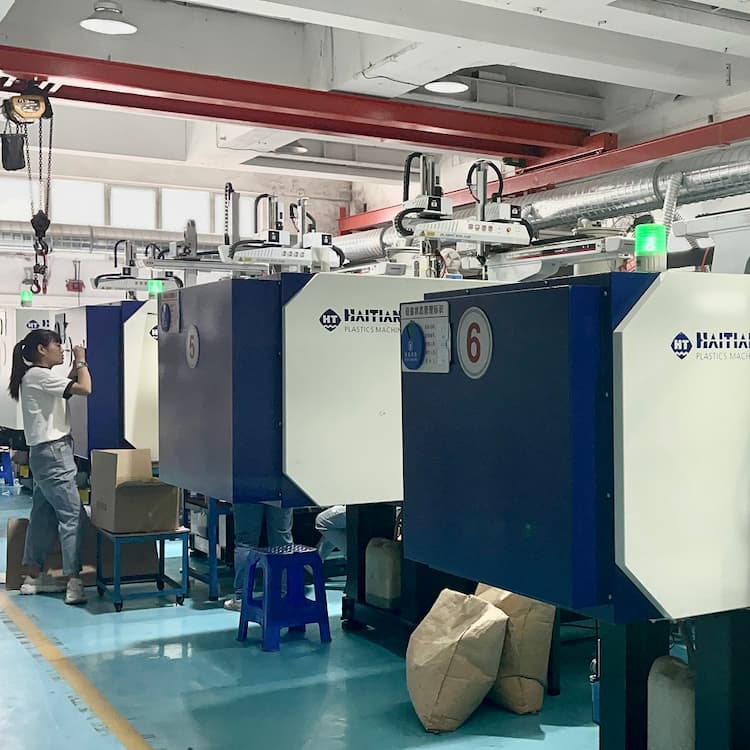
Start by reviewing their equipment list, paying close attention to machine brands, tonnage range, and automation capability. A mature Chinese injection molding supplier typically operates machines from 50T to 1000T or even higher, covering small precision components to large structural parts. Look for facilities equipped with reputable brands such as Haitian, Fanuc, Sumitomo, Engel, or Arburg, as these indicate stability, precision, and good maintenance practices. Check whether they can support special processes like 2K molding, overmolding, LSR injection molding, or insert molding, if required by your project.

Equally important is the supplier’s in-house mold-making capability. The best Chinese manufacturers integrate mold design, mold fabrication, and mold maintenance under one roof, enabling faster turnaround and tighter quality control. Confirm whether the mold shop uses CNC machining centers, EDM, wire-cutting machines, and high-precision measurement tools like CMMs. Ask the factory to share examples of past molds for similar complexity levels—this can reveal their experience with thin-wall structures, complex geometries, tight tolerances, or multi-cavity tools.

Next, assess their process engineering expertise. Reliable suppliers maintain documented parameters for temperature, pressure, cooling, and cycle times for each mold. They should follow best practices such as mold-flow analysis, scientific molding principles, and controlled first article inspections (FAI). When possible, request process data or sample inspection reports for reference.

Finally, consider the strength of their DFM engineering support. The most capable Chinese injection molding manufacturers proactively suggest improvements to wall thickness, draft angles, gate positions, ejector layouts, and assembly interfaces. A supplier that can identify manufacturability risks early will save you time, cost, and potential redesigns.

By carefully evaluating technical expertise—not just quoting speed or prices—you significantly increase your chances of partnering with a factory that delivers consistent quality and long-term reliability.

IV. Mold Design & Engineering Expertise: What to Look for in a Chinese Manufacturer


The quality of your mold determines the quality of every part it produces. Evaluating a factory’s mold design and engineering capabilities is one of the most important steps in selecting a reliable Chinese injection molding partner.

  1. Ability to Perform Professional DFM and Product Feasibility Analysis

A strong engineering team should identify manufacturing issues before tooling begins.

  • Draft angle confirmation and wall-thickness balancing
  • Identification of sink marks, weld lines, and warpage risks
  • Ejector layout, gate type, and parting-line recommendations
  • Proposals to improve manufacturability and reduce tooling cost
    Thorough DFM analysis is the foundation of a smooth and predictable tooling process.
  1. Competence in Mold Structure Design and Complexity Handling

High-quality mold design improves performance, lifespan, and stability.

  • Proper cooling channel design for consistent shrinkage
  • Structural support for thin walls, ribs, and tight corners
  • Slider/ lifter systems for undercuts
  • Hot runner vs. cold runner recommendations based on your volume
    A well-designed mold minimizes defects and shortens cycle time.
  1. Experience with Advanced Mold Types and Specialized Applications

Not all molds are equal; complex parts require specialized engineering.

  • Multi-cavity molds for high-volume production
  • Two-shot molds, overmold molds, or insert-molding setups
  • High-gloss molds for Class-A consumer surfaces
  • Threaded core pulling or collapsible core structures
    A manufacturer with diverse mold experience can handle more ambitious projects.
  1. Use of Simulation Tools and Predictive Engineering

Advanced mold makers use digital tools to reduce trial-and-error.

  • Moldflow analysis for cooling, fill time, and pressure predictions
  • Warpage simulations for large or glass-filled components
  • Gate optimization to minimize weld lines and flow marks
    Simulation-driven design leads to higher first-shot success rates.
  1. Selection of Mold Materials and Steel Grades for Longevity

The steel you choose determines mold durability and maintenance cost.

  • P20 for general use
  • H13/S136 for long-life, high-precision molds
  • 718H and NAK80 for high polish and complex geometry
  • Beryllium-copper inserts for rapid heat transfer
    Knowledgeable material selection ensures your mold meets production volume expectations.
  1. Engineering Responsiveness During Iteration and Changes

Modifications are common in tooling projects, so agility matters.

  • Ability to handle ECNs quickly
  • Transparent communication of impact on cost and timeline
  • Photo/video updates during machining and assembly
  • Professional recommendations instead of passive execution
    Responsive engineering keeps the project moving without unnecessary delays.

V. Quality Control Standards When Selecting an Injection Molding Factory in China


Strong quality control is essential when working with a China-based injection molding factory—especially for custom plastic parts with tight tolerances, cosmetic requirements, or regulatory compliance. While many factories can produce plastic components, only a select group follows rigorous, documented QC systems that ensure stable quality from mold trial to mass production.

Start by checking whether the supplier holds recognized quality management certifications, such as ISO 9001, ISO 14001, or for medical- or healthcare-related products, ISO 13485. Certification alone doesn’t guarantee quality, but it does indicate that the factory maintains structured workflows, traceability, and documented inspection procedures.

Next, look at the supplier’s incoming, in-process, and final inspection controls. Top-tier Chinese injection molding factories follow a layered QC approach involving:

  • IQC (Incoming Quality Control): inspection of resin batches, colorants, components, and outsourced items.
  • IPQC (In-Process Quality Control): monitoring parameters such as melt temperature, injection pressure, cycle time, and humidity for hygroscopic materials.
  • FQC/OQC (Final/Outgoing QC): visual checks, dimensional verification, functional testing, and packaging inspection.

Ask whether the factory uses advanced measurement equipment, such as CMMs, height gauges, pin gauges, optical projectors, colorimeters, and surface roughness testers. Availability of such tools reflects a supplier’s ability to meet detailed dimensional and cosmetic requirements—particularly for consumer electronics, automotive parts, and medical components.

It’s equally important to review their sample inspection reporting, including First Article Inspection (FAI), PPAP, or custom inspection formats. A reliable supplier should provide detailed reports with dimensional data, tolerance analyses, photos, and notes on potential risks or improvement suggestions.

Don’t overlook material traceability and batch control, especially if your parts require UL-rated, food-grade, biocompatible, or flame-retardant resins. The factory should track material lot numbers and store handling logs to prevent mix-ups.

Finally, evaluate the manufacturer’s defect handling and continuous improvement systems. High-quality Chinese injection molding suppliers follow structured methods like 8D reports, root-cause analysis, CAPA processes, and regular internal audits. Their ability to handle issues professionally—rather than making excuses—is one of the strongest indicators of reliability.

Choosing a supplier with mature QC systems directly reduces rejects, stabilizes production, protects your brand reputation, and ensures consistent long-term performance.

VI. Understanding Injection Molding Materials and Resin Support in China


Material selection is one of the most important factors in achieving the right mechanical performance, appearance, and durability. China offers broad access to both global-brand resins and cost-effective local alternatives.

  1. Availability of Commodity Resins

Widely used plastics are readily sourced with short lead times.

  • ABS, PP, PE, HIPS, PVC
  • Cost-effective for general consumer products
  • Reliable supply across China’s major polymer distributors
    Commodity resins are easy to source and ideal for low-cost, high-volume parts.
  1. Access to Engineering-Grade Plastics

For higher strength, durability, and precision, engineering resins dominate.

  • Polycarbonate (PC)
  • Nylon (PA6/PA66), with or without glass fiber
  • POM (acetal)
  • PMMA (acrylic)
    These materials serve demanding applications such as automotive, electronics, and industrial products.
  1. Supply of High-Performance and Specialty Plastics

Complex applications may require elevated mechanical or environmental performance.

  • PEEK, PPS, PBT, LCP
  • High-temperature and chemical-resistant materials
  • Optical or flame-retardant grades
    China’s tier-1 resin distributors offer consistent access to specialized materials.
  1. Global Resin Brands Widely Supported in China

Most international brands have distribution networks in China.

  • Sabic, Covestro, BASF, DuPont, Celanese, LG Chem
  • Material conformity, traceability, and data sheets included
    This ensures global quality standards even when production is in China.
  1. Local Resin Alternatives for Cost Optimization

China also produces reliable local resin equivalents for less critical parts.

  • Cost-effective ABS/PP blends
  • Local PA or PC compounds
  • Competitive pricing for medium-demand applications
    Local options reduce cost while still offering stable performance.
  1. Color Matching, Additives, and Modification Services

Suppliers can tailor materials for specific functional or aesthetic needs.

  • UV stabilizers, flame retardants, lubricants
  • Custom color matching via Pantone or physical samples
  • Compounded materials available through local partners
    Modification services expand material flexibility while controlling cost.

VII. Cost Structure: How Injection Molding Pricing Works in China


Choosing a reliable injection molding manufacturer in China requires understanding how pricing is formed. Unlike simple “per-unit quotes,” injection molding involves several layers of cost drivers. Below is a clear breakdown of the key components that determine the total project cost.

  1. Mold (Tooling) Cost

Mold cost is usually the largest upfront investment and depends on several technical factors:

  • Mold complexity (single cavity vs. multi-cavity, sliders, lifters, unscrewing cores)
  • Steel type (P20, 718H, NAK80, S136, H13)
  • Expected mold life (prototype molds vs. mass-production hardened molds)
  • Surface finish requirements (polishing, texture, EDM, engraving)
  • Part dimensional tolerance and QC requirements

In China, a typical production mold may range from a few thousand USD to tens of thousands depending on complexity.

  1. Material Cost

Material selection significantly affects final pricing:

  • Commodity plastics (PP, PE, ABS, HIPS) → lower cost
  • Engineering plastics (PC, PA, POM, PMMA) → medium cost
  • High-performance plastics (PPSU, PEEK, PSU, LSR) → high cost
  • Special additives (glass fiber, flame retardant, UV stabilizers) increase price further

China’s advantage is strong supply chain availability from brands like Sabic, Covestro, LG, and domestic equivalents.

  1. Production Cost (Machine Time)

This includes:

  • Cycle time (how long each part takes to mold)
  • Machine tonnage required (higher tonnage = higher hourly rate)
  • Operator cost
  • Power consumption
  • Material drying & preparation

Faster cycle time and optimized mold design directly reduce production cost.

  1. Secondary Operations & Post-Processing

Custom parts often require additional steps such as:

  • CNC trimming or deflashing
  • Ultrasonic welding
  • Painting, pad printing, silk screening
  • Assembly and functional testing
  • Laser marking
  • Packaging customization

These processes may add 5–40% to the total cost depending on complexity.

  1. Quality Control Requirements

Higher QC expectations directly influence cost:

  • Incoming material inspection
  • In-process inspections (IPQC)
  • Final inspection (FQC/OQC)
  • Advanced measurements (CMM, laser scanning, tensile testing)
  • Documentation (PPAP, FAI reports, RoHS/REACH compliance)

Projects with tight tolerances or medical/automotive standards require more QC labor and reporting.

  1. Logistics & Export-Related Costs

Typically includes:

  • Shipping (air, sea, courier)
  • Export packaging (cartons, pallets, protective foam)
  • Customs paperwork and clearance
  • Freight forwarding services

Some suppliers offer DDP terms, including door-to-door shipping.

  1. Supplier Margin & Risk Buffer

Every manufacturer adds:

  • Standard operating margin (varies by region and company size)
  • Risk contingency (compensates for defects, rework, or engineering changes)

Top-tier factories generally keep transparent margins and stable pricing, while low-cost suppliers may hide costs or compromise material quality.

  1. Quantity and Long-Term Forecast

Order volume strongly affects pricing:

  • Higher quantities → lower unit price
  • Stable long-term demand → discounted mold cost or free maintenance
  • Prototype-level quantities → higher unit cost

Factories in China prefer ongoing production relationships and often adjust pricing for recurring business.

VIII. Production Capacity, Lead Time & Delivery Reliability of China Mold Makers


Production capability and delivery reliability are critical factors when selecting a Chinese mold maker and injection molding partner. A factory’s ability to meet deadlines, scale production, and ship consistently determines whether your supply chain remains stable as volumes grow.

  1. Mold Manufacturing Capacity and Tooling Throughput

Tooling capacity determines how quickly your project moves from design to trial.

  • Number of CNC machining centers, EDM machines, and wire-cut equipment
  • Parallel mold manufacturing capability (multiple molds built simultaneously)
  • Dedicated teams for rough machining, finishing, and assembly
  • Typical mold lead times for simple vs. complex tooling
    High tooling throughput reduces development time and minimizes launch delays.
  1. Injection Molding Machine Capacity and Scalability

Production scale depends on machine availability and tonnage range.

  • Number of injection molding machines and clamping force coverage
  • Ability to run multi-shift or 24/7 production schedules
  • Support for high-cavity molds and automation systems
  • Capacity planning for peak demand or ramp-up stages
    Scalable machine capacity ensures smooth transition from pilot runs to mass production.
  1. Typical Lead Times for Sampling and Mass Production

Clear timelines help set realistic expectations.

  • Mold design and DFM review timelines
  • T1/T2 sampling lead times
  • Approval-to-production conversion speed
  • Standard production cycle times by material and part complexity
    Defined lead times improve coordination and reduce project uncertainty.
  1. On-Time Delivery Performance and Scheduling Discipline

Reliable factories operate under structured production planning systems.

  • Use of ERP or MES systems for scheduling
  • Order prioritization and production tracking
  • Buffer capacity for urgent orders
  • Historical on-time delivery performance records
    Strong scheduling discipline minimizes shipment delays and missed commitments.
  1. Inventory Management and Production Flexibility

Inventory strategy affects responsiveness and cost control.

  • Finished goods inventory options
  • Safety stock programs for recurring orders
  • Flexible batch sizing for demand fluctuations
  • FIFO material management systems
    Good inventory planning improves responsiveness without unnecessary overstock.
  1. Logistics Coordination and Export Experience

Delivery reliability extends beyond the factory floor.

  • Experience with FOB, EXW, CIF, and DDP shipping terms
  • Export documentation accuracy (packing lists, COO, HS codes)
  • Partnerships with reliable freight forwarders
  • Familiarity with destination country compliance requirements
    Efficient logistics coordination ensures products arrive on time and without customs issues.
  1. Risk Management and Contingency Planning

Reliable suppliers prepare for unexpected disruptions.

  • Backup machines and tooling redundancy
  • Preventive maintenance schedules
  • Emergency production recovery plans
  • Transparent communication during disruptions
    Proactive risk management protects your supply chain from unexpected delays.

IX. Communication, Project Management & IP Protection When Working with Chinese Manufacturers


Clear communication, structured project management, and strong intellectual property (IP) protection are essential for successful long-term cooperation with Chinese injection molding suppliers. These factors often determine whether a project runs smoothly or encounters costly misunderstandings.

  1. Establish Clear and Documented Communication Channels

Written communication reduces ambiguity and prevents costly errors.

  • All specifications, drawings, and tolerances documented in writing
  • Change requests confirmed through formal ECN (Engineering Change Notice)
  • Use of shared folders or PLM systems for document control
  • Defined primary points of contact on both sides
    Clear documentation ensures expectations are aligned and traceable.
  1. Evaluate Project Management Structure and Responsiveness

A structured project team improves execution speed and accountability.

  • Dedicated project manager or account engineer
  • Defined milestones for tooling, sampling, and production
  • Regular progress updates with photos, videos, or reports
  • Clear escalation paths for urgent issues
    Strong project management keeps timelines predictable and transparent.
  1. Confirm Language Proficiency and Technical Communication Ability

Technical accuracy depends on effective communication.

  • Engineers and PMs fluent in technical English
  • Ability to discuss drawings, GD&T, and material specifications
  • Clear written summaries after meetings or calls
  • Understanding of international quality and compliance standards
    Effective communication minimizes rework and misinterpretation.
  1. Protect Intellectual Property with Legal and Operational Measures

IP protection requires more than verbal assurances.

  • Signed NDA / NNN agreements enforceable under Chinese law
  • Clear ownership definition for molds, tooling, and designs
  • Restricted access to sensitive drawings and data
  • Internal IP control procedures within the factory
    Well-structured IP protection safeguards your designs and investments.
  1. Control Mold Ownership, Storage, and Usage Rights

Mold ownership must be contractually clear.

  • Written confirmation that molds are customer-owned
  • Mold identification plates with customer name or ID
  • Defined rules for mold relocation or transfer
  • Access rights for mold inspection or audit
    Clear ownership prevents unauthorized use or duplication.
  1. Manage Quality Issues with Formal Documentation

Structured issue resolution improves accountability.

  • NCR reports with root-cause analysis
  • Corrective and preventive action (CAPA) documentation
  • Photo/video evidence for defects
  • Defined approval process for deviations
    Formal documentation ensures problems are resolved permanently, not temporarily.

X. Final Supplier Selection Checklist & Best Practices for Injection Molding in China


Before committing to a long-term injection molding partner in China, a structured final evaluation helps reduce risk and ensures alignment across technical, commercial, and operational aspects. This checklist consolidates best practices into actionable decision points.

  1. Confirm Technical and Manufacturing Capability Match

Ensure the supplier’s strengths align with your specific project needs.

  • Proven experience with your part complexity and industry
  • Appropriate mold-making capability (precision, cavity count, steel grade)
  • Familiarity with required materials and tolerances
  • Demonstrated ability to meet cosmetic and functional requirements
    A capability match reduces development risk and rework.
  1. Validate Quality Systems and Performance History

Past quality performance predicts future results.

  • Documented QC systems (IQC, IPQC, OQC)
  • Sample inspection reports and capability data (Cp/Cpk)
  • Certifications such as ISO 9001, ISO 13485, or IATF 16949
  • Clear corrective action and traceability processes
    Reliable quality systems ensure consistency over long production runs.
  1. Review Cost Transparency and Quotation Structure

Clear pricing prevents disputes and hidden costs.

  • Separated tooling and unit pricing
  • Defined mold life assumptions and maintenance terms
  • Clarified cost drivers (material, cycle time, cavity count)
  • Quotation validity and revision rules
    Transparent pricing enables accurate budgeting and forecasting.
  1. Assess Lead Time Commitment and Delivery Reliability

On-time delivery is critical to your supply chain.

  • Realistic mold and sampling lead times
  • Historical on-time delivery performance
  • Capacity flexibility for ramp-up or urgent orders
  • Logistics and export experience
    Delivery reliability protects product launch schedules and customer commitments.
  1. Confirm Communication, Documentation, and Project Control

Strong communication prevents misunderstandings.

  • Dedicated project manager and escalation path
  • Written specifications and version-controlled drawings
  • Formal ECN and approval processes
  • Regular progress reporting
    Well-managed communication keeps projects on track and predictable.
  1. Secure IP Protection and Mold Ownership Rights

Legal clarity protects your long-term interests.

  • NDA/NNN agreements enforceable in China
  • Written mold ownership confirmation
  • Mold usage, storage, and transfer conditions
  • Data security and access control measures
    Strong IP protection safeguards your designs and investments.
  1. Start with a Pilot Project or Trial Order

A controlled trial reduces risk before scaling.

  • Small-volume production run
  • Evaluation of quality, communication, and responsiveness
  • Assessment of problem-solving ability
  • Verification of actual lead times vs. promises
    Pilot projects provide real-world validation before full commitment.
  1. Plan for Long-Term Partnership and Continuous Improvement

The best suppliers grow with your business.

  • Willingness to optimize cost and cycle time
  • Openness to process improvement initiatives
  • Stable management and workforce
  • Long-term collaboration mindset
    Strategic partnerships deliver greater value over time than transactional sourcing.

XI. Conclusion: Choosing the Right Injection Molding Partner in China


China remains one of the world’s most competitive and capable destinations for injection molding, offering a unique combination of advanced tooling expertise, scalable production capacity, broad material availability, and cost efficiency. However, success in sourcing injection-molded parts from China depends not on geography alone, but on a disciplined and methodical supplier selection process.

A reliable Chinese injection molding partner must demonstrate more than competitive pricing. Strong mold design and engineering expertise, structured quality control systems, material and resin support, predictable lead times, and proven delivery reliability are essential foundations for consistent production. Equally important are clear communication practices, professional project management, and enforceable intellectual property protection to prevent misunderstandings and safeguard long-term investments.

By thoroughly evaluating technical capabilities, quality standards, cost structures, production capacity, and operational transparency, buyers can significantly reduce sourcing risk and avoid common pitfalls. Starting with a pilot project and building a relationship based on documented processes and mutual accountability further strengthens confidence before scaling to mass production.

Ultimately, the most successful injection molding projects in China are built on strategic partnerships rather than transactional sourcing. When the right supplier is chosen, manufacturers can leverage China’s mature ecosystem to achieve high-quality parts, stable supply chains, and sustainable cost advantages over the long term.

Partner with a trusted Injection Molding expert to accelerate your product development. GEMS-MFG is the comprehensive solution provider here for you. As a one-stop custom manufacturer, we provide a wide range of services, including rapid prototyping, mold making, injection molding, CNC machining, die casting, and more.

Whether your requirements involve intricate prototypes or precision parts, GEMS-MFG is committed to delivering an efficient and cost-effective solution tailored to your needs. Contact us today [INFO@GEMS-MFG] to explore our offerings and receive an instant quote. Your manufacturing goals are our priority.


How to Find a Reliable Injection Molding Manufacturer in China for Custom Plastic Parts

Why GEMS MFG?

Integrated Factory Resources

We are your one-stop manufacturing solution provider for customized products with the joint effort & support from our 120 partnership subcontractors mainly for the production of metals & plastics. We can expand much faster but the top management decide to keep GEMS a compact, dedicated and professional company, which allows our team to really focus and deliver on your projects without any excuse or compromise. We strive to be a long-term, reliable and trustworthy partner of our customers rather than just being a contractor, and look forward to growing the company with customers’ success.

Manufacturing Veteran Team

With the passing years, we are proud to build up a manufacturing veteran team with rich experience and full expertise to fulfill your specific demand. From mold making, injection molding, die casting, stamping and sheet metal, to 2nd processes like CNC machining, oil spraying, powder coating and chrome plating, and then assembling and packaging and related, we always have someone in house to be an expert to resolve the issues in different stages of product development. We also specialize in providing charger, cable and hub, plus other electronic accessories that support a complete set of product.

Strong Project Management

“Think global, execute local” is the principle of our work. Time, quality and cost are the three key elements to be considered throughout the product development from concept design to mass production. A detailed plan with weekly conference call update is a critical gateway to ensure these three key elements are successfully implemented, also assuring that all parties are on the same page. Communication is the Secret to Success . Everyone works independently to take care his own job, but together we are a team to get things done and are your daily eyes and ears onsite in China.

Flexible Operation & Customization

We offer a wide variety of products, such as mold, component and assembly product, and certain value-added services. For logo or branding product, we have in house resources to complete a color mix that can perfectly match a brand’s unique colors in fast and cost-effective way. Understood the client needs production parts but having a hard time to find a vendor since the order quantity is as low as 1000 or lower. GEMS is well set up for low volume injection molding or die casting projects. Surely our team is also capable of building SPI Class 101 mold that is designed & made for 1 million cycles or more of producing the same high quality parts consistently.